Research
Objective, affordable colour quality control for the textile industry — from an IoT monitoring study to a working machine vision system.
Low-cost real-time fabric colour variation detection
Manuscript in preparation · IEEE- Field
- Machine vision, colour science, textile quality control
- Hardware
- Logitech C270 HD USB webcam; bilateral 5500 K daylight-balanced LED panels
- Software
- Python, OpenCV, NumPy, Flask, desktop app (pywebview)
- Institution
- Multimedia University, Malaysia
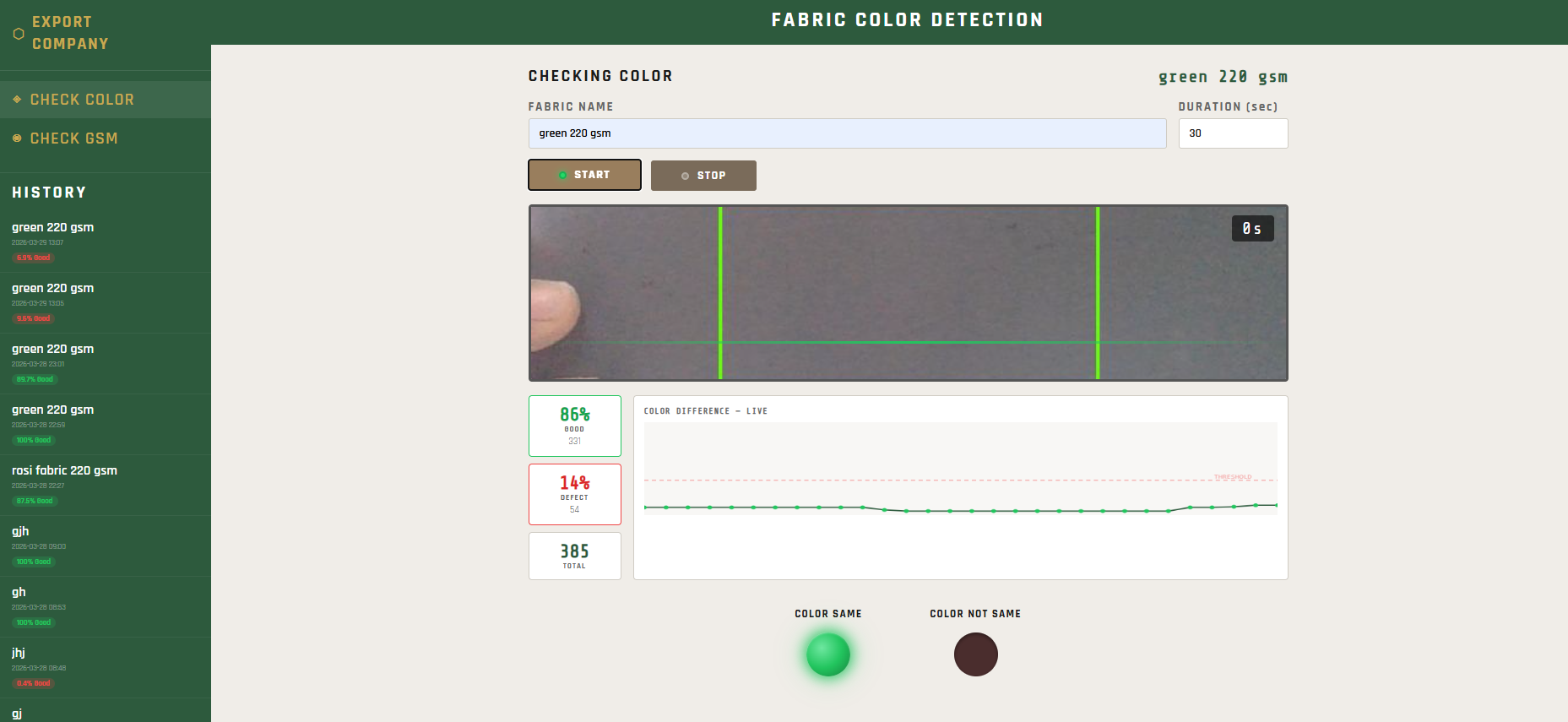
Spectrophotometers measure colour accurately, but they are expensive, read one small spot at a time and are used off-line. Manual inspection is fast but subjective. This system sits between the two: a webcam in a controlled lighting booth watches a large area of fabric and reports colour differences in real time.
Each frame is converted to CIELAB and the median colour of the inspection region is compared with a reference using CIEDE2000, the current CIE recommendation. Before any test, five checks must pass — camera ready, not too dark, not over-exposed, stable over time, and evenly lit across a 3 × 3 grid. A calibration step measures the system's own noise on a uniform fabric and sets the pass/fail limit above it, so the system never reports noise as a defect.
The software separates the measurement camera from any other camera: a laptop webcam still works for demonstrations, but its results are clearly marked as demo readings.
Adoption of IoT-Enabled Quality Monitoring System in a Smart Factory
Presented at ICTIM 2026- Authors
- Md Rasel Khandaker, Siva Priya A/P Thiagarajah (corresponding)
- Affiliation
- Faculty of Artificial Intelligence and Engineering, Multimedia University, Cyberjaya, Malaysia
- Venue
- 6th International Conference on Technology and Innovation Management (ICTIM 2026)
- Type
- MSc research paper
- Status
- Presented
Bangladesh's textile sector still relies largely on manual inspection, which is estimated at only 60–75% accuracy. This quantitative cross-sectional study compared eight factories in Bangladesh — five IoT-enabled and three without IoT — through a survey of 80 quality management professionals, using the Technology Acceptance Model (TAM) and the Technology–Organisation–Environment (TOE) framework.
All six hypotheses were supported at p < 0.01. IoT-enabled factories reported markedly lower shade mismatch (Cohen's d = 4.11) and were 5.32 times more likely to report lower defect rates. Non-IoT firms were 12.86 times more likely to see implementation cost as a critical barrier, and digital training correlated strongly with user satisfaction (r = 0.826). These findings motivated the low-cost machine vision system above.
Education
Master of Science (MSc)
Engineering Business Management, specialisation in AI and Intelligent Systems
Multimedia University, Malaysia
Bachelor of Science (BSc)
Textile Engineering
Sonargaon University, Bangladesh